
Sections
- The alternatives to fine mesh
- Screens and punched covers under firs
- How a hood sheds debris
- Fitting any of them
- When each one makes sense here
- Why inserts let owners down
- Relative costs
- Guard types side by side
- Hoods and the look from the street
- When a budget screen still makes sense
- Removing old guards
- Moving up to mesh
- Guard words
The alternatives to fine mesh
| Guard | Principle | Fir needles | Downpours | Relative cost |
|---|---|---|---|---|
| Plastic or metal screen | Open grid laid over the trough | Fall through and mat | Fine while clean | Low |
| Punched aluminum cover | Holed metal sheet | A share slip in | Fine while clean | Middle |
| Reverse-curve hood | Water wraps round a nose into a slot | Can follow water into the slot | Can overshoot | Middle to high |
| Foam insert | Porous foam filling the trough | Caught on top | Slows drainage | Low |
| Brush insert | Bristles filling the trough | Woven into the bristles | Fair | Low |
Screens and punched covers under firs
Both keep out bigleaf maple and alder leaves well enough. Needles are the trouble: they drop through the openings of a screen or wedge in the holes of a cover, and a season or two later the guard may be wearing a mat thick enough to keep rain out.
How a hood sheds debris
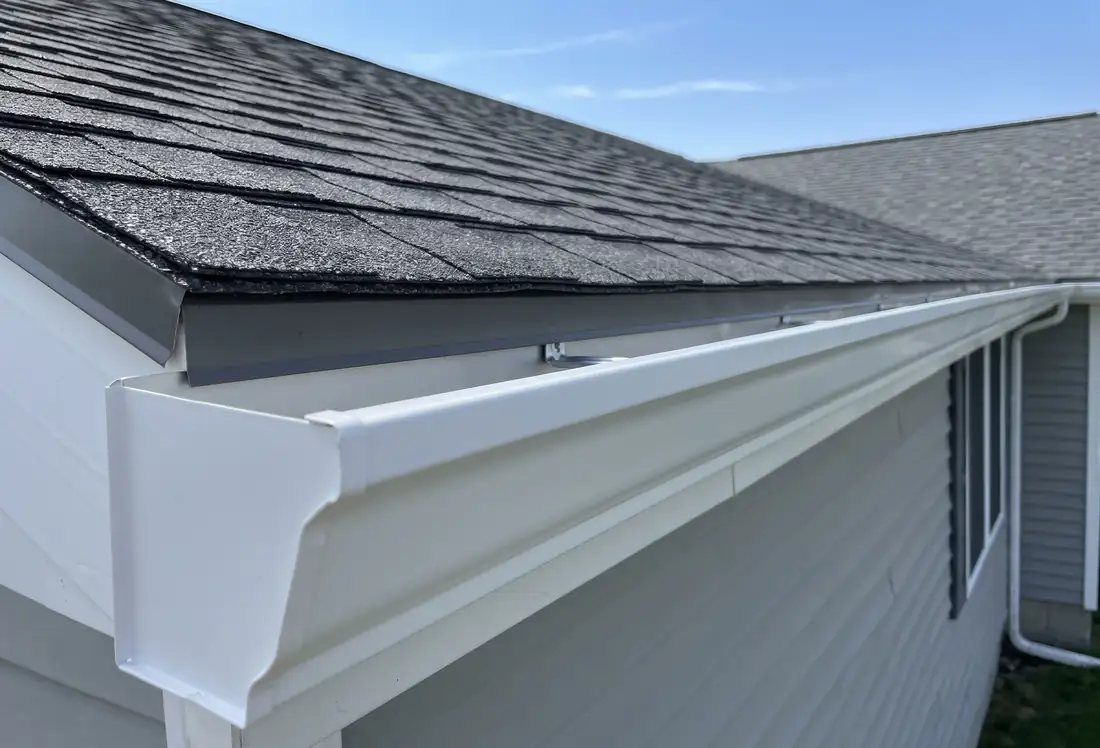
A solid cover runs out from under the shingles and over the gutter to a rounded nose. Water clings to the curve and turns into a slot behind it while leaves slide off the front. It copes with moderate rain. Needles, however, can ride the water into the slot and build up out of sight.
Fitting any of them
- Start with an empty gutter
- Fix leaks and sags first
- Screens snap or screw to the lip; hoods slide under the shingles and fix to the gutter front
- Confirm water still reaches every drop afterwards
When each one makes sense here
| Situation | Reasonable choice |
|---|---|
| Mostly maple or alder, few conifers | Punched cover or hood |
| Heavy fir or cedar cover | Fine mesh instead |
| Tight budget, single level, easy to reach | A screen, checked often |
| Wide overhang where looks matter | Hood, with the slot cleaned |
More in micro-mesh guards and are gutter guards worth it.
Why inserts let owners down
Foam and brush inserts catch debris instead of shedding it and stay damp, which in this climate grows moss and stains the gutter. Most end up in the bin within a few seasons.
Relative costs
Screens and inserts are the cheapest and mostly sold for DIY. Punched covers sit in the middle. Hoods fitted by a professional are usually the most expensive of the group. Ask exactly what the price covers.
Guard types side by side
| Type | How it works | Under firs | Under maples |
|---|---|---|---|
| Snap-in plastic screen | Coarse grid sits in the gutter | Needles pass through or lodge in the grid | Leaves stay out |
| Perforated aluminum | Sheet with small holes | Needles lie on top, some slip through | Works well |
| Reverse curve (hood) | Water follows the rounded nose into a slot | Needles collect at the nose | Leaves slide off |
| Foam insert | Porous block fills the gutter | Traps needles, grows moss | Leaves sit on top |
| Brush insert | Bristles stand in the trough | Needles tangle in bristles | Leaves caught on top |
Hoods and the look from the street
Reverse-curve hoods cover the gutter entirely and change the look of the eave, adding a smooth rounded front. On some homes that reads as a tidy fascia; on others it looks bulky. Ask to see photos of a hood on a house like yours before deciding.
When a budget screen still makes sense
On a detached garage, shed or single-level eave with open sky and occasional leaves, a simple screen can be enough. Under tall conifers, or where cleaning is hard and expensive, fine mesh usually earns back its higher price.
Removing old guards
If you are switching types, old screens and inserts need to come out and the gutter cleaned beneath them. Ask whether that is in the quote.
Moving up to mesh
If a screen or insert is not coping with needles, fine mesh can usually replace it on the same gutters. The old guard is removed, the gutter cleaned and checked, and the new guard fitted along each run.
Ask how each guard is removed for cleaning.
Easy removal makes occasional cleaning much quicker.
Guard words
| Word | What it means for a peninsula house |
|---|---|
| Reverse curve | A solid hood guard whose rounded nose steers water back into a slot |
| Perforated cover | A cover of sheet metal or plastic with rows of holes |
| Micro-mesh | Woven stainless screening with tiny openings, carried on a rigid frame over the trough |
| Drip edge | Bent metal flashing at the roof edge, under the bottom shingles, that throws runoff out past the trim and into the gutter |
| Moss | Low green growth that colonizes damp, shaded roofs and sheds clumps into gutters |