
Sections
What goes on most Gig Harbor homes?
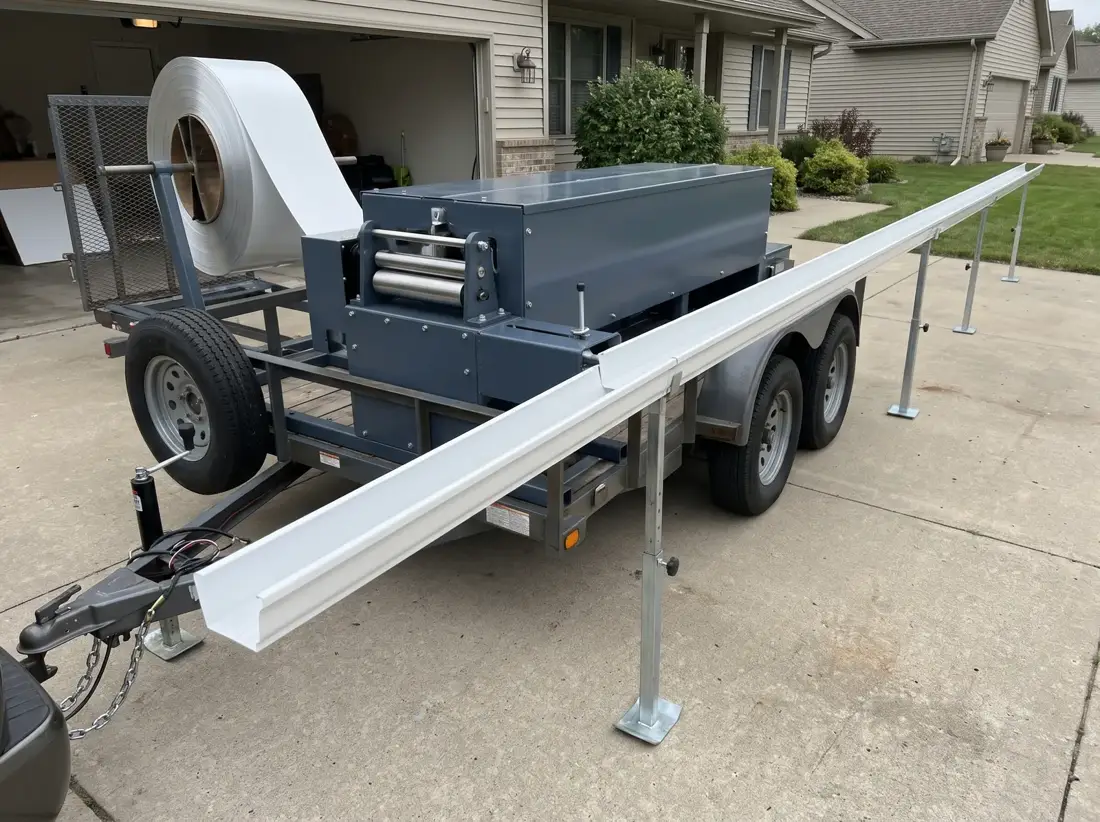
Seamless aluminum K-style gutter in 5 or 6-inch widths with rectangular leaders. The installer arrives with a trailer-mounted forming machine and painted coil, and rolls out each run to the length of its wall, so the only joints sit at corners and drops.
| Decision | Usual peninsula choice | When it differs |
|---|---|---|
| Shape | K-style | Older harbor homes and craftsman designs may suit half-round |
| Width | 6-inch on two-level and steep roofs | Low ramblers and cabins often do fine with 5-inch; see 6-inch gutters |
| Metal | Aluminum, 0.032 inch | Copper on some waterfront and custom homes |
| Joints | Seamless | Sheds and outbuildings the machine cannot reach |
| Leaders | 3x4 under firs; 2x3 on small open roofs | See downspouts |
Installation day, step by step
- Measure every eave. Length, roof pitch, valleys and where water can safely go at ground level.
- Check the wood. Fascia probed for rot, drip edge or apron looked for, rafter ends inspected.
- Prepare on the ground. Outlets cut and sealed, end caps fitted, before anything goes up a ladder.
- Hang to a line. Chalk marks the slope, and concealed hangers follow it about every 24 inches.
- Make corners. Miters riveted and sealed, with diverters under any fast valley.
- Run the leaders. Fixed to the siding with straps and ended at a pad, an extension or a sealed pipe.
- Flush it. A hose down every run to prove the fall and the outlets.
What makes peninsula gutters different?
Long wet seasons. Gig Harbor averages about 37 inches of rain a year, with December the wettest month. Rain tends to arrive day after day rather than all at once, so gutters run for long periods and any slow leak or soft board gets plenty of time to rot.
Conifer debris. Firs and cedars shed through every season, and wind adds cones and twigs. Needles pack into outlets and bind with moss into dense mats that hold water.
Moss and shade. North-facing and tree-shaded roofs grow moss, which sheds into gutters and keeps the trough damp.
Wind. Winter storms bring branches down on eaves. In the November 2024 bomb cyclone, falling trees knocked out power to roughly half a million Washington customers.
Slopes and bluffs. Many lots fall toward the water. Ecology notes landslides are common along Puget Sound's steep shoreline bluffs, so leader water needs a planned route.
How big should new gutters be?
| House | Gutter | Leaders |
|---|---|---|
| One-level rambler, few trees | 5-inch | 2x3, one per 30 to 35 feet |
| One-level under firs | 5 or 6-inch | 3x4 |
| Two-level subdivision house | 6-inch | 3x4 at corners and below valleys |
| Waterfront house with several roof levels | 6-inch, extra outlets | 3x4 into a planned tightline |
| Older harbor home | 5-inch K-style or 6-inch half-round | 2x3 or round leaders |
| Detached shop or garage | 5-inch | 2x3, away from the doors |
What does installation cost?
National figures from Angi and This Old House quote fitted one-piece aluminum gutter in a band of about $9 to $13 a foot at 5 inches wide, rising to $12 to $18 at 6 inches. No one publishes a Gig Harbor rate, so use those as a frame and expect the house itself to decide the final number. The Gig Harbor cost guide works through sample houses.
What should the written quote include?
- Company name, phone and L&I number
- Insurance certificate
- Feet of gutter, plus the count and size of leaders
- Profile, width, metal and coil weight
- Gutter and leader colors
- Hanger type and spacing
- How corners will be made
- Where every leader will discharge
- Removal of any old gutters
- Fascia repair rate per foot
- Guards, if any, by brand and type
- Total price and payment schedule
Who can install gutters here?
Washington asks construction contractors to register with Labor & Industries and carry a bond and insurance. Get the number and check it on L&I's site before anyone climbs a ladder. Installation and repair need that registration; L&I lists gutter cleaning among services that do not.
Before the contractor arrives
A little preparation makes the measuring visit quicker and the quote more accurate.
- Clear access. Move cars, planters and outdoor furniture away from the walls, and tell the contractor about gates, dogs and steep or soft ground.
- Note the problem spots. Corners that overflow, joints that drip and places where water pools are worth pointing out.
- Know your drainage. Find where each leader ends now, whether into a buried pipe, a splash block or the lawn.
- Think about guards. If firs or maples overhang the roof, ask for a price with and without mesh.
- Check HOA rules. In neighborhoods with an association, color and style may need approval.
After installation
Walk round with the contractor before they leave. Look for even fall toward each outlet, neat corners, leaders strapped firmly to the wall and outlets carrying water clear of the foundation. On the first heavy rain, watch for any drips or spills and report them quickly.
Installation vocabulary
| Word | What it means for a peninsula house |
|---|---|
| K-style | The everyday residential profile, named for its crown-molding front; sold 5 and 6 inches wide |
| Half-round | An open semicircle gutter held in brackets, used on older and traditional homes |
| Coil | Prepainted sheet on a spool, fed into the forming machine on site |
| Hidden hanger | A concealed bracket spanning the trough just below the lip, fixed by a long screw through the gutter back into the board |
| Hand-cut miter | A corner shaped from the gutter itself on site, with one sealed seam |
| Outlet | The sleeve sealed through the gutter bottom where water leaves for the leader |
| Fall | The gentle slope a gutter is set at so water runs to the outlet, about a quarter inch per ten feet |
| Drip edge | Bent metal flashing at the roof edge, under the bottom shingles, that throws runoff out past the trim and into the gutter |
| Gutter apron | Flashing tucked up under the shingles whose lower lip drops into the gutter, so nothing runs down the back |
| Tightline | A sealed, solid pipe that carries roof water to a chosen outlet, often down a slope or bluff |