
Sections
Leader sizes
| Leader | Goes with | Typical job |
|---|---|---|
| 2 by 3 rectangular | 5-inch K-style | Small roofs, open lots |
| 3 by 4 rectangular | 6-inch, or 5-inch under conifers | Two-level homes, valleys, fir cover |
| 3-inch round | 5-inch half-round | Cottages and older homes |
| 4-inch round | 6-inch half-round | Bigger half-round systems |
| 4 by 5 and larger | Box gutters | Commercial roofs |
The 3x4 carries about twice what a 2x3 does and is much harder for needles and small cones to plug.
Counting drops
A working rule is one leader per 30 to 35 feet of gutter, plus one near every valley and at the far end of any long run. Under heavy firs, an extra drop shortens the distance debris travels before it can leave.
Places to send the water
| Method | What it does | Fits |
|---|---|---|
| Splash pad | Breaks the stream at the foot of the wall | Flat yards already falling away |
| Extension | Moves the stream 4 to 10 feet from the wall | Most homes; hinged ones flip up for the mower |
| Dispersion | Spreads water over gravel or a trench | Lots with room and soil that drains |
| Tightline | Sealed pipe to a chosen outfall | Bluffs, steep ground, cramped lots |
| Rain barrel | Holds water for the garden | Garden use, with an overflow route |
| Rain garden | A planted hollow that soaks it up | Roomy yards with absorbent soil |
Bluffs change everything
Ecology describes landslides as common along Puget Sound's steep shoreline bluffs, and WSU's Shore Stewards points out that homeowners have set off slides by sending water over the edge. On a slope or waterfront lot, a leader should never just empty at the top of the bank. A tightline carries the water in sealed pipe to a safe outfall, and a conservation district guide notes that some outlets placed on the beach can need a state Hydraulic Project Approval.
Fitting a leader
- Drop outlet cut into the gutter floor and sealed
- Top elbows set to bring the pipe back to the wall
- Lengths joined with each upper piece sliding inside the one below
- Straps near the top and bottom, with more every 6 to 10 feet
- A lower elbow turning water away from the wall
- An extension, pad, dispersion trench or tightline at the bottom
- A hose test to check the flow
What the county and city encourage
Pierce County's rain garden program asks homeowners to let rain soak in, and its rain barrel sheet notes the county gets 38 to 56 inches of rain a year depending on location. The City of Gig Harbor's stormwater pages explain how roof runoff can cause erosion and flooding. Inside city limits, its stormwater manual covers roof downspout controls for new development, so ask before altering a connected system.
Pricing
Usually per leader or per foot, with extensions, tightlines and emitters itemized on top.
Planning drops before installation
The best time to decide where leaders go is before the gutter is made. Walk round with the contractor and agree each drop: near valleys, at the ends of long runs, and where water can be carried safely away. Moving a drop later means cutting a new outlet and patching the old one.
| Spot | Why add a drop there |
|---|---|
| Below a valley | Takes the concentrated flow |
| Every 30 to 40 feet of run | Keeps water from travelling too far |
| Near a path to a rain garden | Feeds it without long pipes |
Sizes and shapes
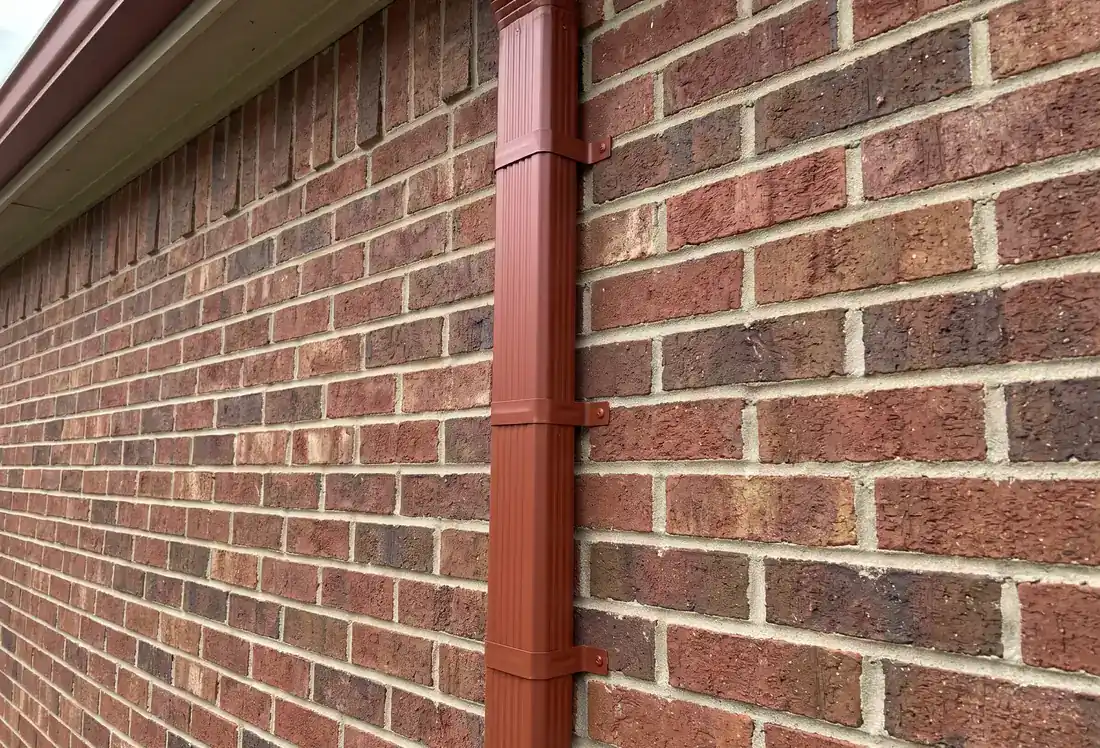
Leaders come in rectangular 2x3 and 3x4 sizes for K-style gutters, and round sizes for half-round. Under trees, 3x4 is the common choice because needles and small cones pass through more easily.
Each drop should end where water can move away from the house safely.
Agree each outlet before the gutter is formed and hung on the house.
Leader and drainage words
| Word | What it means for a peninsula house |
|---|---|
| Downspout | The pipe carrying water from the gutter outlet to the ground; also called a leader |
| Outlet | The sleeve sealed through the gutter bottom where water leaves for the leader |
| Elbow | A bent downspout fitting that turns the pipe toward the wall, away from it or sideways |
| Strap | A bent strip fixed to the siding to hold the leader tight |
| Splash block | A shaped pad under the downspout that breaks the stream so it does not scour the ground |
| Extension | Added pipe or a hinged length at the downspout foot that carries water further out |
| Tightline | A sealed, solid pipe that carries roof water to a chosen outlet, often down a slope or bluff |
| Dispersion trench | A gravel-filled trench that spreads downspout water out so it soaks into the ground gradually |
| Cleanout | An access point with a cap, at the base of a leader feeding underground pipe, for clearing blockages |