
Sections
The five usual causes
| Where it spills | Most likely cause | Fix |
|---|---|---|
| Beside a downspout | Outlet or elbow plugged with needles | Clear and flush; upsize to 3x4 |
| Along the whole length, even when clean | Trough too small for the roof | Move to 6-inch |
| At an inside corner | A valley pouring into one spot | Diverter, extra drop or 6-inch |
| Partway along | A dip holding a puddle | Refix to a fresh line |
| At the far end only | Too far to the only drop | Add a drop |
Working out which one you have
- Watch in a steady rain and note exactly where water comes over
- Check whether the leader below is running or dry
- Look along the gutter from the end for dips
- Note any valleys above the spill
- After a clean, see whether it still overflows in the next rain
Why overflow is so common here
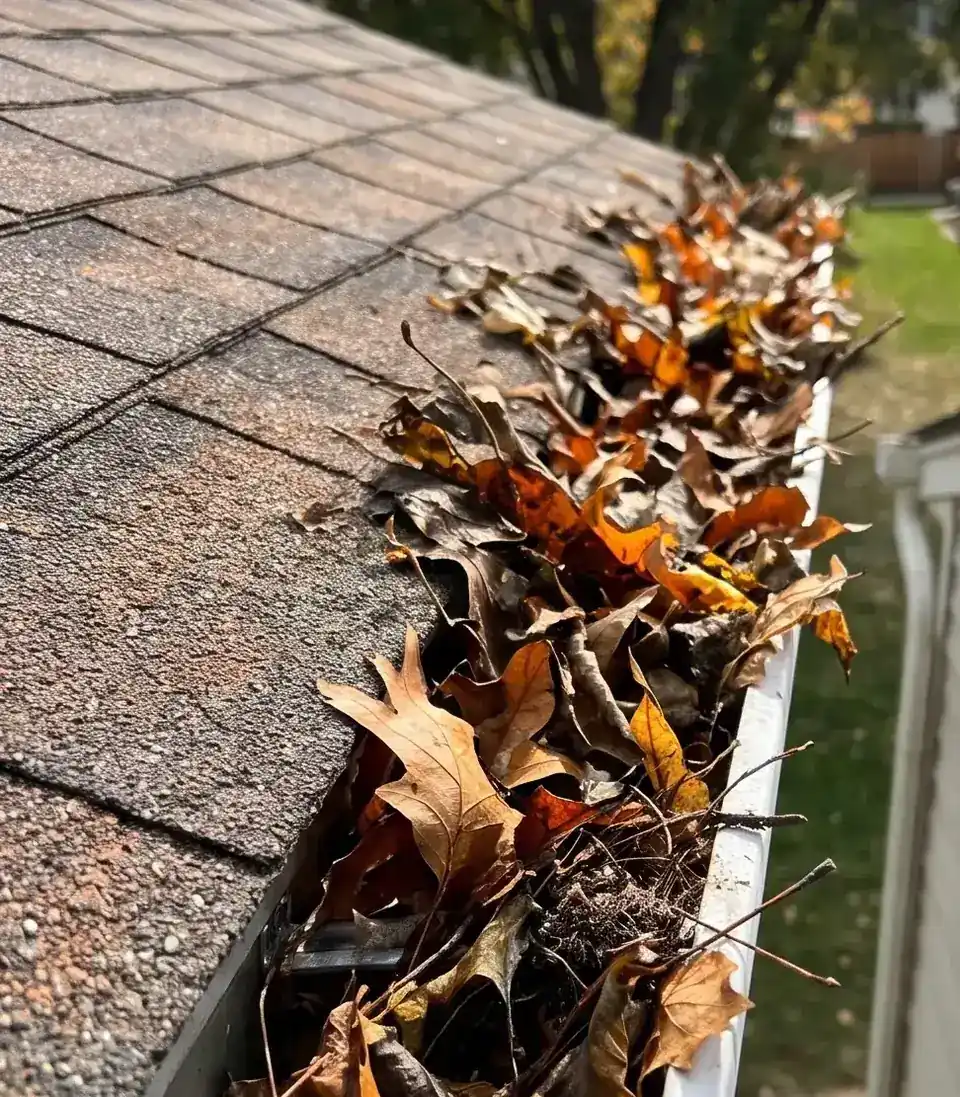
Conifers. Fir and cedar needles plug drops faster than broad leaves, and they keep falling all year.
Moss. Clumps washed off the roof lodge in outlets and hold the needles in place.
Long rain. With about 37 inches of rain a year, with December the wettest month, a gutter that drains slowly spills for days, not minutes, soaking fascia and the ground by the foundation.
Undersized originals. Many houses still carry the 5-inch gutters and 2x3 leaders they were built with, under trees that have since grown tall.
What overflow damages
- Fascia and soffit soaked from the front
- Siding and window trim streaked and wet
- Beds and paths washed out below the eave
- Crawl spaces and foundations wetted by water landing at the wall
- Steps and decks made slippery with algae
Clean, upsize, or guard?
If overflow stops after a clean, the problem is debris: plan regular cleaning or fit micro-mesh guards. If it continues in steady rain with a clean trough, the system is undersized: see 6-inch gutters. If it spills at one corner, a valley diverter or an extra drop near the corner often solves it.
Who to call
A registered gutter contractor for drops, diverters, refixing and upsizing; a cleaner for routine debris removal.
Find where the water leaves
Stand outside during a steady rain, ideally with an umbrella and a notepad. Where water pours over is the best clue to the cause, and it saves the contractor time on the visit.
| Where it overflows | Usual cause | Usual answer |
|---|---|---|
| Inside corner below a valley | Two roof planes meeting | Extra drop or valley diverter |
| Middle of a run | Sag or a clog of needles | Clean and rehang |
| Right at the outlet | Blocked drop or leader | Clear outlet and leader |
| Along the whole eave | Gutter too small for the roof | Upsize to 6-inch, add drops |
| Only in downpours | Leaders too small | Move to 3x4 leaders |
| Behind the gutter | Missing drip edge or apron | Add flashing |
Overflow behind the gutter
Water that runs down the fascia behind the gutter, rather than over its front lip, usually means there is no drip edge or gutter apron guiding roof water into the trough. That is common on older peninsula homes re-roofed without edge flashing, and it is a major cause of rotten fascia. Fitting an apron is usually a modest add-on to a repair visit.
Leaders that cannot keep up
In heavy rain, a 2x3 leader can be the bottleneck even when the gutter is clean and sized well. Swapping to 3x4, or adding a second drop on a long run, gives water an easier way out.
Gutters set too low
If a gutter hangs too far below the roof edge, water can shoot over it in heavy rain. Raising it closer to the drip edge, with the right fall toward the outlet, keeps water landing in the trough.
Check after every big storm.
A note of the time and the side of the house helps the contractor diagnose it quickly.
Overflow words
| Word | What it means for a peninsula house |
|---|---|
| Outlet | The sleeve sealed through the gutter bottom where water leaves for the leader |
| Elbow | A bent downspout fitting that turns the pipe toward the wall, away from it or sideways |
| Valley diverter | A small fin set in the gutter below a roof valley to turn rushing water along the trough |
| Fall | The gentle slope a gutter is set at so water runs to the outlet, about a quarter inch per ten feet |
| K-style | The everyday residential profile, named for its crown-molding front; sold 5 and 6 inches wide |
| Micro-mesh | Woven stainless screening with tiny openings, carried on a rigid frame over the trough |