
Sections
Reading the sag
| How it looks | Probable reason | Repair |
|---|---|---|
| Front tilting out, gap at the back | Spikes have backed out of the board | Refix with screw-in hangers |
| A belly in the middle | Hangers far apart, heavy wet debris | Empty it, add hangers |
| One end hanging low | Board soft at a corner | New fascia, then refix |
| Puddles that never drain | Slope lost | Refix to a new line |
| A curve pressed into the front | Ladder or branch | New length |
Getting it straight again
- Empty the trough so the weight comes off
- Test the board with a screwdriver all along the low section and at both corners
- Swap out any spongy board
- Snap a chalk line giving roughly a quarter inch of drop per ten feet
- Lift the gutter to the line and screw in hidden hangers about two feet apart
- Run water through and look for anything left standing
Peninsula causes
Waterlogged debris. Fir needles and moss behave like a sponge. One winter of that load can bend hangers and work spikes loose.
Board rot. With about 37 inches of rain a year, with December the wettest month, any water that slips behind the gutter keeps the fascia damp for months, until screws have nothing to grip.
Old spikes. Spike-and-ferrule fixings on older houses loosen as the wood swells and shrinks with the seasons.
Storms. Gusts and falling limbs lever a loaded gutter away from the eave.
Why tapping spikes back fails
Its hole has already widened, so it will back out again before long. Screw-in hangers bite fresh wood and spread the load, which is what makes the fix last.
Refix or replace?
| Condition | Outcome |
|---|---|
| Gutter and board sound, fixings loose | Refix |
| Long stretches of spongy board | New fascia, then refix or replace |
| Front creased or kinked | Swap that length |
| Too small, spills in steady rain | Move up to 6-inch |
Cost of straightening a gutter
Usually charged per run or per foot, with new fascia by the foot of board. Nothing is published locally, so ask for hanger style and spacing in writing, plus a per-foot rate for any extra rot.
What a sag does over a wet winter
A gutter that dips even half an inch between hangers holds a puddle after every rain. On the peninsula, that puddle rarely dries out between October and April. Needles settle into it, moss starts, and the extra weight pulls the gutter further down. The low spot can overflow onto the same patch of siding or soil all winter, staining the wall and softening the ground near the foundation.
| Where it sags | Likely cause | Typical fix |
|---|---|---|
| Middle of a long run | Hangers too far apart, weight of debris | Add hidden hangers, clean |
| Near a corner | Soft fascia or a loose miter | Replace board, refix corner |
| Under a tree | Limb strike or heavy debris load | Straighten or replace section |
| Along the whole eave | Old spikes working loose | Rehang with screws, reset fall |
| At the downspout end | Weight of water at the outlet | Support the outlet, add a hanger |
Resetting the fall
Rehanging is a chance to check the slope. Gutters need a gentle fall toward each outlet so water does not sit. A contractor will often snap a chalk line along the fascia and hang to it, rather than following the old, sagging position.
When the sag comes back
If a refixed run drops again within a season, look behind it. Screws that cannot bite because the fascia is soft, or a rafter tail that has rotted, will not hold any hanger. That calls for repairing the wood first, which is covered in fascia and soffit repair.
Hanger spacing
Hidden hangers at about 24 inches apart are common; on exposed or heavy-debris eaves, closer spacing helps the gutter keep its line.
On older homes, spikes are usually swapped for screws during the refix.
Screws bite into sound wood and resist the pull of a full trough much better than old spikes.
Sag repair words
| Word | What it means for a peninsula house |
|---|---|
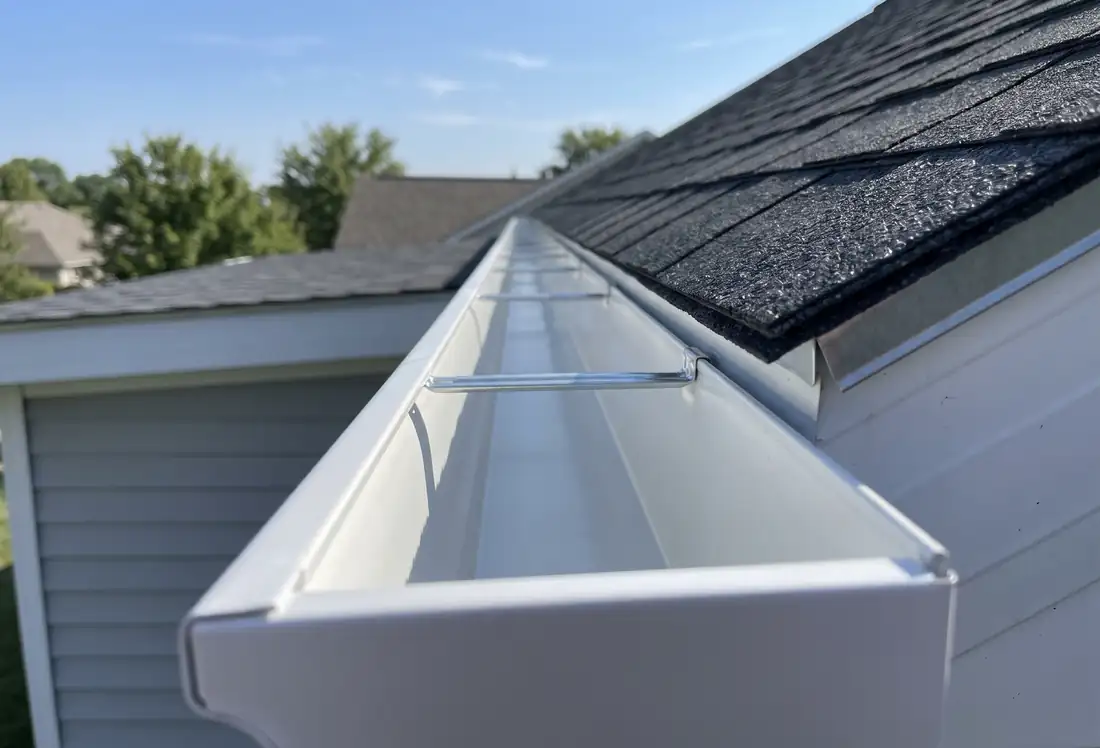
| Hidden hanger | A concealed bracket spanning the trough just below the lip, fixed by a long screw through the gutter back into the board |
| Spike and ferrule | An old fixing method: a nail driven through both faces of the gutter with a tube to stop it crushing |
| Fascia | The board capping the rafter ends along each eave; it carries every gutter fixing |
| Fall | The gentle slope a gutter is set at so water runs to the outlet, about a quarter inch per ten feet |
| Rafter tail | The projecting tip of a roof rafter; the fascia board is fixed across these |